
Mallorca – February by Rental Car
In February 2025, the two of us spent a week on Mallorca. Our base was a clifftop hotel in Santa Ponça. Add a rental car and a road bike packed in a bike case. From there we headed to a different corner of the island every day: up to Cap de Formentor, down to Sa Calobra, into the mountain villages of the Tramuntana and out to the southeast coast. In the end, the bill came to €1,724 for two, including flights, hotel and rental car.
1,000 vs. 1,200
Shortly after landing, two numbers didn't add up at the Click Rent desk. Our credit card had a limit of 1,000 euros. The deposit for the rental car was 1,200 euros. In between lay 200 euros and a whole week of plans on an island that, without a car, is only half as big in February.
We did some quick maths and made a decision. You'll find out which one under “Getting around”.

Mallorca in February is a different island from the one in the summer brochure. Many beach bars take a break, the sea is chilly, and it's dark by around half past six. In return, the almond trees are in bloom, and the hairpin roads belong to road cyclists and a handful of rental cars. At Cap de Formentor you can drive right up to the lighthouse, where the shuttle bus takes over in summer. Consti spent most of his time on the road bike in the mountains. Emma went hiking, sometimes alone, sometimes with him. At lunchtime we met up in a village for coffee, tapas and far too much bread with aioli.
Looking for one specific answer? Use the overview to jump straight to the right section.
Quick facts
Best time to visit If you want to swim, come in summer. If you want to hike, cycle and explore villages, February is your month. It's mild, the roads are empty, and the almond trees bloom from late January to around early March, most reliably in February. The weather is moody: a sunny day can be followed by a cool, windy or wet one. We were there in mid-February and saw the almond blossom. The sea was too cold for us, but for our way of travelling, February was just right.
Currency Euro. All prices in this article are as of February 2025.
How long to stay A week worked well for us. From a base in the southwest, every corner of the island is doable as a day trip. Next time, though, we'd spend more time in the Tramuntana and drive fewer kilometres back and forth across the island.
Entry requirements Spain is part of the EU and the Schengen Area. German citizens only need their national ID card.
Internet and power EU roaming applies, so your phone plan works just like at home and you won't need a local SIM card. The plug sockets are the same as in Germany, so you can leave the adapter at home.
Language The official languages are Spanish and Catalan. On the island people speak Mallorquí, a variety of Catalan, which is why many place names on signs use the Catalan spelling. In the tourist areas you'll get by fine in English and often in German too.
Expensive / cheap Rather cheap in February. Flights, hotel and rental car cost a lot less than in summer – the two of us paid €1,724 for the whole week. Some things still cost whatever they like: in a shop on the promenade we paid €12 for sunscreen. A restaurant meal came to around €60 for two.
Good to know The Serra de Tramuntana in the northwest is a UNESCO World Heritage Site, and its highest peak is Puig Major at 1,445 metres. February is road cycling season on Mallorca, so expect to share the bends on mountain roads. And not every orange by the roadside is meant for eating: many trees carry bitter oranges. We tried one so you don't have to.
Can you wild camp? No. Wild camping is banned on Mallorca, with particularly strict checks on beaches and in nature reserves. Campervans may only park on designated sites. This time we slept in a hotel.
Getting there
Our trip began at 9 pm with a 520-kilometre night drive to Düsseldorf. In the car: snacks, the long-haul playlist and a firm resolution to ignore the tiredness. The only interruptions came from the recurring debate about whether another toilet break was really necessary.
Our airport parking was about two kilometres from the terminal and cost €39 for the week. In return, we had to hand over the car key, because the cars get moved to a lot further away. We hesitated briefly, then handed it over. A week later, the car was waiting for us without a scratch.
The shuttle started running at 3 am, and ten minutes after loading up we were at the terminal. The check-in desks opened at 4 am. We'd printed our boarding passes at home, and the regular luggage was gone in no time. Only the bike case insisted on special treatment and had to wait for the oversized baggage drop-off. That had a side effect: thanks to the special luggage, we were first in line at the desk.
Security was quick. We took off at 6:15 am, and two hours later we were on Mallorca.
Getting there – February 2025Car park approx. 2 km from Düsseldorf Airport · €39 for one week · key handover, the car is moved · shuttle from 3 am, approx. 10 minutes to the terminal · bike case as special luggage: €50 per flight
Getting around
The deposit problem

We didn't want to explore Mallorca in February without a car. We'd booked with Click Rent, a rental company near the airport with a shuttle from the terminal. Compact class, hop in, drive off – that was the plan.
Then came the deposit. 1,200 euros were to be blocked on the credit card, and its limit was 1,000 euros. We had two options: stay stuck without a car for the week, or take out additional insurance for 168 euros, which reduced the deposit to 200 euros. We took the insurance. Annoying, but a week without a car would have cost us more than 168 euros.
Our most important tip for this island: before you travel, check your credit card limit and compare it with your rental car deposit. If it's not enough, get it raised beforehand. That saves money and the discussion at the desk.
Rental car – February 2025Click Rent, office near the airport with shuttle · compact class · €342.44 for the week including additional insurance, young driver fee and return outside opening hours · deposit €1,200 without or €200 with additional insurance (€168)
Buses in hibernation
In summer, the buses connect the well-known sights fairly well. In February they run on reduced timetables, and some remote corners aren't served at all. If you want to be spontaneous and see the mountain villages or the capes, you'll hardly get around a rental car.
Curves, curves, curves

The roads are well built, but very winding in the Tramuntana. At Cap de Formentor and especially on the way to Sa Calobra, it's one hairpin after another. If you get car sick easily, sit up front or drive yourself.
Plan the scenic roads for the morning or early afternoon. In February it's dark by around half past six, and hairpin bends in the dark are no fun for anyone.
Fuel and parking – February 2025filled up twice: €145.72 at €1.59 per litre · parked four times: approx. €10 in total
Accommodation

We stayed at the Sentido Fido Punta del Mar Hotel in Santa Ponça. The hotel sits on a cliff above the sea, which leads straight to our first tip: don't pay extra for a sea view. Every room has one.
Breakfast was our secret favourite of the week: fresh orange juice, sparkling wine, a chocolate fountain. The outdoor pool was closed in February, but there's a small spa with a heated pool and massages. What stuck with us most was the staff, who were friendly every single day.
Santa Ponça is in the southwest, close to the airport, and quiet in the off-season. By car, you can reach every corner of the island from there. If you mainly want to see the mountain villages, you'll be closer in the Tramuntana. If you plan to spend a lot of time in the north, a base around Pollença saves driving time.
For a quiet, lovely hotel with a view, we'd book it again.
Accommodation – February 2025Sentido Fido Punta del Mar, Santa Ponça · every room with sea view · spa with heated pool · flight and hotel package: €857 for two people, one week
Food / Shopping

Our lunches followed a fixed pattern: we met up in a village for coffee, tapas and bread with aioli. Every time, there was more bread than we actually wanted.
We went out for dinner three times, each for around 60 euros for two. [PRÜFEN: Namen und Orte der drei Restaurants ergänzen, gern mit einem Gericht, das hängen geblieben ist]
A few specialities are tied to particular places. In Valldemossa, it's Coca de Patata, a sweet potato pastry eaten with hot chocolate. Around Sóller, much revolves around citrus fruit – the valley is known for its orange groves.
The biggest everyday issue in February is opening hours. Many restaurants and small shops have reduced hours or close for the winter, and the information online is often wrong. Call ahead or ask locally, or you'll find yourself standing hungry in front of a locked door at 2 pm.
We spent around 50 euros on snacks and drinks over the week. The most expensive single purchase was sunscreen: 12 euros in a shop on the promenade. Better to pack it from home. And while you're at it, pack a rain jacket too.
Highlights
Our highlights follow what we did most on Mallorca: driving bends, exploring villages, heading to the coast and keeping moving.
Cap de Formentor: right up to the lighthouse
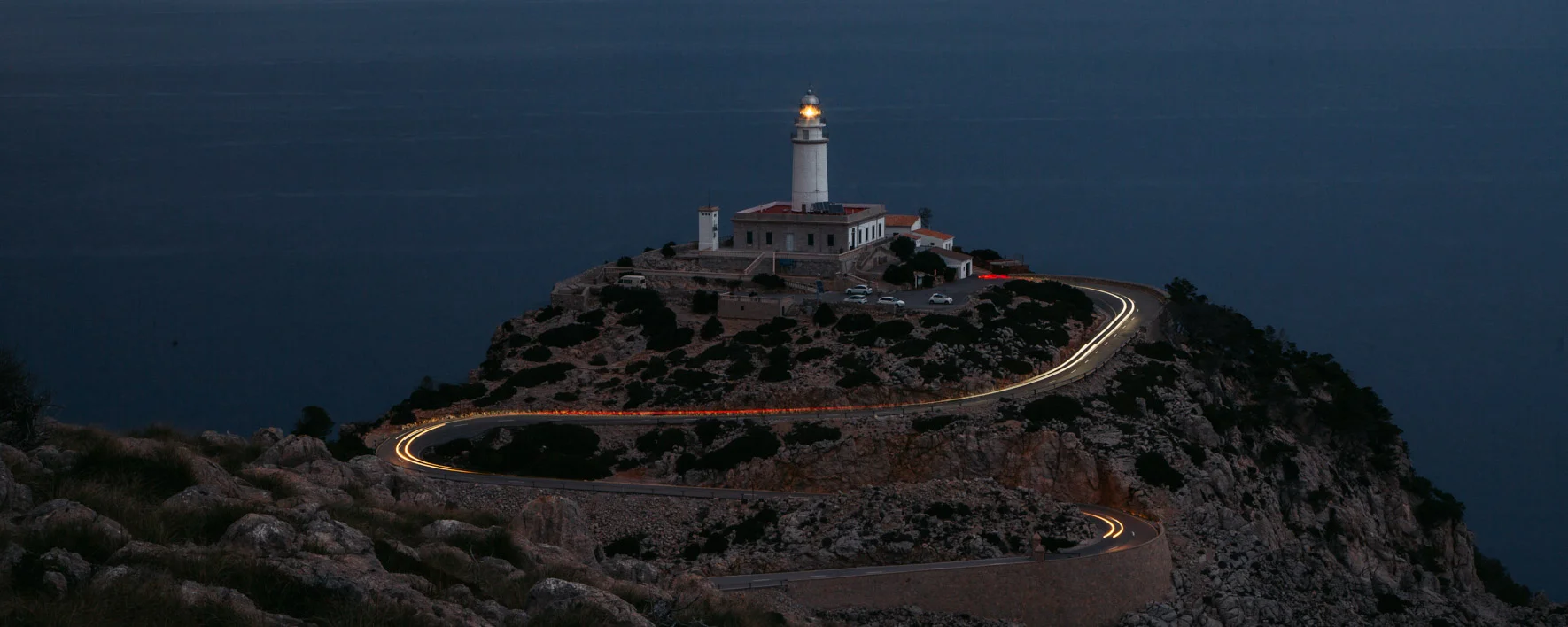
The island's northernmost point is where February pays off most clearly. In high season, the road to the lighthouse is closed to private cars during the day, and shuttle buses run from Port de Pollença instead. The authorities set the exact period anew each year; in 2025 the closure lasted until the end of October. In February, we could drive all the way to the lighthouse without any restrictions.
The road winds across the peninsula in tight bends. From the passenger seat, Emma found it a little nerve-racking more than once. At the top, the cliffs drop steeply into deep blue water, and on a clear day you can see all the way to Menorca. The lighthouse has stood there since 1863, 210 metres above the sea.
One note: even in winter, the road is sometimes closed for roadworks. So check quickly before you set off whether it's open.


Sa Calobra: the road with the tie knot
The road down to Sa Calobra is one of the best known on the island and one of the twistiest. It was designed by Italian engineer Antonio Parietti and built in the early 1930s. At its most famous spot, the Nus de sa Corbata (the “tie knot”), it makes a 270-degree turn and passes underneath itself. Parietti supposedly got the idea while tying his tie. On the way down you get a good view of it and briefly wonder where the road actually came from.
We'd rather not talk about our nausea level on this descent. At the bottom, the reward awaits: the cove between towering rocks and the Torrent de Pareis, a gorge that opens straight into the sea.


The mountain villages

Valldemossa, Deià, Pollença and Sóller with Port de Sóller lie in or on the edge of the Tramuntana and were our favourite lunch stops. In February their alleys are quiet, and the cafés are filled more with locals than tour groups. All four villages, with tips and our impressions, have their own article.
Es Pontàs

On the southeast coast near Santanyí stands Es Pontàs, a natural rock arch in the sea. The waves have carved an arch into the rock that is now one of the island's best-known photo spots. It's not a hiking destination but a viewpoint. It's especially beautiful in the late afternoon, when the light falls low across the coast.
Road bike, hiking boots and a lunch table

During the day we often went our separate ways. Consti rode his road bike into the mountains, Emma went hiking, sometimes alone, sometimes together. On some days Consti did a hike first and then a bike ride on top. At lunchtime we met up in a village and compared kilometres over bread with aioli.
February is a great time for cycling on Mallorca: pleasant temperatures, hardly any traffic and roads that seem built for exactly this. If you bring your own bike, factor in the transport. Our bike case cost 50 euros per flight.
Reisetipps
Ob Kreditkarte, Versicherung oder SIM-Karte – hier findet ihr alle wichtigen Themen kompakt zusammengefasst.
Good Travel
More Life

Departure
We had booked the return outside opening hours. But when we pulled up, someone from Click Rent was already there. The car got a quick once-over, everything was fine, and the shuttle took us to the airport.
Where we then arrived far too early. We had planned to walk to the terminal if necessary, and we didn't need that buffer. Still, we'd rather be too early at the airport than too late.
Our tip: ask at pick-up whether the shuttle also runs when you return the car outside opening hours. Then you'll know how much buffer you really need.
Costs
All figures are for two people and our week in February 2025.
| Item | Cost for two people |
|---|---|
| Flight & hotel (package, one week) | €857.00 |
| Rental car incl. additional insurance, young driver fee and return outside opening hours | €342.44 |
| Restaurant meals (3 × approx. €60) | approx. €180.00 |
| Fuel (2 ×, €1.59/litre) | €145.72 |
| Bike case as special luggage (2 × €50) | €100.00 |
| Groceries (snacks, drinks) | approx. €50.00 |
| Parking at Düsseldorf Airport (1 week) | €39.00 |
| Parking on the island (4 ×) | approx. €10.00 |
| Total | approx. €1,724.16 |
That's around 862 euros per person for a week including flights, hotel and rental car.
Where you save: Timing is the biggest lever. Flights, hotel and rental car are much cheaper in February than in summer. The car park with shuttle in Düsseldorf was also a good deal at 39 euros a week. And in winter you can drive your own rental car all the way to the lighthouse at Cap de Formentor without relying on the shuttle bus.
Where it hurt: the 168 euros for additional insurance. With a higher credit limit, we wouldn't have needed it. That was the most annoying expense of the trip.
Where it was worth it: the rental car. Without it, we wouldn't have seen half the island in February. And the hotel, whose breakfast lived up to its location every single morning.
Conclusion
Our week in numbers:
- 520 kilometres of night driving to Düsseldorf
- 1 bike case with special requests, 2 × 50 euros
- 200 euros between credit limit and deposit, bridged with 168 euros of insurance
- 270 degrees at the tie knot of Sa Calobra
- 365 steps in Pollença and sore calves
- 12 euros for sunscreen
- 1,724.16 euros for two people and one week
Mallorca in February is for anyone who wants to keep moving on an island: hiking, cycling, driving bends, wandering through villages. The roads are empty, there's hardly anyone ahead of you at the viewpoints, and the almond blossom comes as a bonus. If you're after beaches, pool bars and long evenings outdoors, February isn't for you. The sea is chilly, the days are short, and part of the food scene is on its winter break.
What we'll do differently next time: raise the credit limit before the trip. And spend more days in the Tramuntana instead of driving so many kilometres back and forth across the island.
Thanks for reading this far. If you know Mallorca outside the season too, tell us which corner we missed. Hopefully our next coordinate has fewer bends.
Emma & Consti


Affiliate Links & Kaffeekasse
Danke,
dass du dabei bist!
Bei den mit (*) gekennzeichneten Links handelt es sich um Affiliate Links. Gleicher Preis für dich, eine kleine Provision für uns, um den Blog zu unterstützen! Alternativ kannst du uns auf einen virtuellen Kaffee einladen – wir verzichten für eine bessere Nutzerfreundlichkeit bewusst auf Werbeanzeigen.