
Switzerland – Car Camping Road Trip
In late May 2023 [PRÜFEN: Reise Ende Mai bis Anfang Juni 2023?], the two of us spent five days driving through Switzerland. It was our very first road trip. We were travelling in the in-laws' borrowed Seat Alhambra and slept in the boot. The route took us from Basel via Bern and Sion to Ticino, on to Graubünden and home via Liechtenstein: four language regions, one car train and three bikes.
Two people, three bikes

The maths of this trip never added up. There were two of us, and we had three bikes on board.
The third one was a track bike. One of us had raced shortly before, and the bike simply stayed in the car afterwards. A track bike has no brakes and no gears. We took it to a country that consists largely of downhill. It didn't ride a single metre there. It still took up space every single evening.
Because every evening meant rebuilding. The boot became the bed, the front seats became the bike garage, and the luggage found whatever space was left. In the morning we knew where we wanted to go. Where we'd sleep usually only became clear towards evening.
In between came a train you drive your car onto, a valley with clear, blue-turquoise water, a factory full of graffiti and a night in which our pitch slowly turned into a pond.
If you only need one specific answer, take the shortcut via the line below.
Quick facts
Best time to travel. For a road trip, late May to September works well. We were there in late May and early June: the valleys were green and the well-known spots were still quiet. Expect rain – we had a whole night of it in Ticino. Many high Alpine passes only open in June. If your route crosses a pass, check beforehand whether it's open.
Currency. Swiss francs (CHF), in Liechtenstein too. You can pay by card practically everywhere. Euros are often accepted, but your change comes back in francs and at a poor rate. Unless stated otherwise, our prices are from May 2023.
How long to stay. We had five days for the whole route, and that was too tight. For the same route we'd plan seven to ten days. Switzerland is small, but the roads are winding, and each stage takes longer than the distance suggests.
Entry requirements. Switzerland isn't part of the EU, but it is part of the Schengen Area. For EU citizens, an ID card is enough. The same applies to Liechtenstein; the border there is open.
Internet and power. EU roaming doesn't automatically apply in Switzerland. Whether your plan covers Switzerland depends on your provider. Sort this out before you leave, otherwise mobile data gets expensive. Alternatives are a day pass or an eSIM. The plug sockets are Type J: flat Europlugs fit, chunky Schuko plugs don't. An adapter costs a few euros.
Language. There are four national languages: German, French, Italian and Romansh. On our route the language changed three times, each after a few hours' drive. Standard German is understood everywhere in German-speaking Switzerland. Understanding Swiss German is another matter entirely. If in doubt, English will get you through the whole country.
Expensive or cheap? Expensive, across the board: fuel, groceries, camping, entry fees. We didn't write much down on this trip, but the difference to Germany showed at every checkout. Cooking for yourself and sleeping in the car brings costs down significantly. It still doesn't make it cheap.
Good to know. Supermarkets are largely closed on Sundays; exceptions are at train stations and larger petrol stations. You need a vignette for the motorways – from the very first kilometre. And speeding is punished far more harshly than in Germany. More on that under "Getting around".
Can you wild camp? Partly. There's no nationwide rule; cantons and municipalities decide for themselves. It's banned in nature reserves, wildlife rest areas and the National Park. Above the tree line, a single night is usually tolerated. In the valleys and with a car it's much stricter – in the Verzasca Valley there was only one permitted pitch. Check the canton's rules beforehand.
Getting there
We set off from Dudenhofen in the Palatinate [PRÜFEN: War das Radrennen dort, und seid ihr direkt danach los?]. From there we drove along the French border to Basel. From southern Germany, it's the easiest journey to another country you can get: no ferry, no flight, just motorway.
At the border, one thing changes immediately for drivers. The motorway beyond costs money, and you pay in advance. So buy the vignette at the border crossing at the latest. Everything about it is in the next section.
Also, do your shopping before the border. Whatever supplies you have in the car, you won't have to buy at Swiss prices. The duty-free allowances are listed under "Food & shopping".
Getting around
The vignette
You need a vignette for motorways and expressways. There's only the annual vignette – a ten-day version like in Austria doesn't exist. We paid CHF 40, about €44. You don't need it on ordinary roads. But if you're crossing the country, there's no way around it.
At the time of our trip it was only available as a windscreen sticker. Since August 2023 there's also a digital version, linked to your number plate.
Vignette – May 2023CHF 40 · valid for the calendar year · required on motorways and expressways
Driving onto the train

From Brig in Valais we wanted to get to Ticino. In between lies the Simplon. We skipped the pass and took the car transport train.
Here's how it works: you drive onto an open wagon, switch off the engine and stay in your seat. Then it goes dark. About 20 minutes later you roll off the train again in Iselle di Trasquera in Italy. Being carried through a mountain in your own car without steering was the most relaxing stretch of the whole trip.
In bad weather or when you're short on time, the car train is the better choice than the pass. Timetable and prices are on the operator's website. EXTERNER LINK: Betreiberseite Autoverlad Simplon (Fahrplan und Preise), Adresse fehlt
Simplon car train, Brig – Iselle – May 2023CHF 26 for car and passengers · about 20 minutes
Roads, speed limits, fuel

The roads are in excellent condition, even the small ones in the mountains. They are narrow, though. In the Verzasca Valley, two cars can only just squeeze past each other in places.
The speed limits are 50 in towns, 80 outside towns and 120 on the motorway. The blood alcohol limit is 0.5. Fines are high and rise quickly; beyond a certain margin it becomes a matter for the courts. We drove very politely for all five days.
We preferred to fill up once too early. There are plenty of petrol stations along the main routes; in the side valleys they get rare.
We drove home via Austria. That meant another toll – €10 in our case.
Leave the car behind for a day
One day we parked the car in Filisur and took the Rhaetian Railway to Davos. The ride is in the highlights. Swiss trains are expensive, but punctual, and they reach valleys where you'd hardly expect a road.
By the way, we did use the other two bikes. Here and there the two of us went for a short ride [PRÜFEN: Wo? Ein Ort oder eine Szene würde hier gut passen].
Route
Our route in five days. The distances are rough estimates.
| Day | Stage | Distance |
|---|---|---|
| 1 | Dudenhofen – Basel – Attisholz Areal – Bern – overnight spot between Bern and Lausanne | approx. 400 km |
| 2 | Overnight spot – Le Gruyère – Chillon Castle – Sion | approx. 180 km |
| 3 | Sion – Brig – car train – Iselle di Trasquera – Verzasca Valley | approx. 160 km plus train |
| 4 | Verzasca Valley – Filisur – train to Davos and back – pitch in Graubünden | approx. 190 km plus train |
| 5 | Graubünden – Vaduz – home via Austria | long |
[PRÜFEN: Kilometer sind von mir geschätzt. Fahrzeiten fehlen ganz. Bitte mit Routenplaner gegenchecken oder Spalte streichen.]
Where we rushed
Day 1 was too full. The drive there, Basel, Attisholz and Bern in one day means you only get a quick glimpse of each stop. Basel and Bern could each easily fill half a day.
The Verzasca Valley was too short. We had one day and would have loved three.
And we underestimated the drive from Ticino to Filisur. On the map the two cantons sit right next to each other. In between are the Alps, and the road takes the detour over the San Bernardino. If you want to see both Ticino and Graubünden, plan a separate driving day for it.
Accommodation / Pitches

We spent every night sleeping in the car. The Alhambra is big enough for it if you rearrange everything each evening. For us that took about fifteen minutes: bikes to the front, luggage in between, bed in the back.
We found our spots with the park4night app. It shows official motorhome pitches, campsites and tolerated car parks, with reviews. For a trip without booked accommodation it was our most important tool.
The first night we stayed between Bern and Lausanne [PRÜFEN: Ort und Art des Platzes].
Sion – the evening when nothing happened

In Sion we stayed at a campsite [PRÜFEN: Name und Preis]. We had a barbecue, it got dark, the crickets chirped and the stars came out above us. That was it. It was the quietest evening of the trip and the one we talk about most often.
Verzasca Valley – the pitch that became a pond
In the middle of the Verzasca Valley there's just one officially permitted pitch. It cost CHF 24 per night and sits right in the green.
During the night it started raining and didn't stop. We were parked in a slight dip. We only noticed when the water pointed it out. Wearing waterproof Crocs, we sealed up the car and moved whatever could be moved. By morning the Alhambra was standing in a puddle that no longer deserved the name.
Since then, the first thing we check at every spot is the ground. Where will the water run when it rains? If you're at the lowest point, find another spot – even if the sky is still blue.
Verzasca Valley pitch – May 2023CHF 24 per night · the only official pitch in the valley
Graubünden – the pitch with floodlights
In Graubünden we found a quiet corner one evening [PRÜFEN: Ort, kostenlos?]. We rearranged everything, made the bed and lay down. Only then did we notice the street lamp we were parked under. Our car has a sunroof. Instead of stars, we saw the lamp – all night long. It felt like sleeping in a station waiting room.
Since then, after checking the ground comes looking up. Both before rearranging anything.
Packliste
Du bist noch unsicher, was du alles in deinen Rucksack packen musst? Unsere Packliste hilft dir bei der Planung – mit praktischen Tipps und einer erprobten Liste aus eigener Erfahrung.
Zur Packliste
Pack light
Explore more
Food / Shopping
We almost always cooked or grilled for ourselves. That was down to the budget and the camping grill, which was coming along anyway.
The big supermarkets are Migros and Coop. Denner, Aldi and Lidl are cheaper. Almost all of them are closed on Sundays. If you notice your supplies are empty on Saturday evening, you'll only find something at train stations and larger petrol stations.
Meat, alcohol and drinks are noticeably more expensive in Switzerland than in Germany. Shopping before the border pays off, as long as you stay within the allowances. Per person, 1 kg of meat and 5 litres of wine or beer, among other things, are duty-free, plus a value limit of CHF 150 for all goods combined [PRÜFEN: aktuelle Freimengen beim Schweizer Zoll gegenchecken].
Tipping: service is included in the price. Rounding up is common; nobody expects more.
What we tried
In Basel, it has to be Läckerli. This hard, spiced honey biscuit has been made there for more than 700 years. We bought a bag to form an opinion. The bag was empty quickly.
At the Le Gruyère cheese dairy, the tour ended with the cheese in several stages of ageing. The young one is mild and creamy, the old one strong and slightly crystalline. Taste them side by side – only then do you notice how far apart they are. Afterwards we bought cheese, just like everyone else in the room.
Swiss chocolate also found its way into the boot. There wasn't much room left.
The Attisholz Areal has cafés and food trucks. Kantine Attisholz is a good place for a break between the halls.
Highlights
Our route ran through all four language regions. That's the order we tell it in.
German-speaking Switzerland
Basel

Basel was our first stop across the border. The city has the highest density of museums in Switzerland. Even so, we chose the outdoors and went looking for street art. A walk around includes the red sandstone Basel Minster and the Mittlere Brücke across the Rhine [PRÜFEN: Szene oder Eindruck aus Basel ergänzen].
Attisholz Areal

Between Basel and Bern, near Solothurn, there's an old pulp mill. It produced for 127 years until it closed in 2008. Since 2018 part of the site has been open, and the walls belong to the sprayers.
We walked through the halls, past rusty steel beams and graffiti stretching over several storeys. Some pieces are political, others show fantasy creatures. In between, parts of the old plant are still standing, as if someone had just stepped out for a break.
Entry and parking are free. In Switzerland, we checked that twice.
Attisholz Areal – May 2023Free entry · free parking · cafés and food trucks on site
Bern

Bern's Old Town is a UNESCO World Heritage site. Under its arcades you can walk six kilometres without getting wet – a real argument on a rainy day. Along the way are the Zytglogge clock tower and, at the end of the Old Town, the BärenPark (bear park) on the Aare [PRÜFEN: Szene oder Eindruck aus Bern ergänzen]. For us, Bern was the third stop on day 1 and so didn't get enough time.
Romandy
Le Gruyère

At the show dairy La Maison du Gruyère, you can smell what it's all about from the entrance. From a gallery you watch the cheesemakers at work while large vats stir below.
One number stuck with us: a 35 kg wheel takes around 400 litres of milk. After the tour, you look at the cows by the roadside with more respect. The tasting is covered under "Food / Shopping".
Chillon Castle

The castle stands near Veytaux, right in Lake Geneva, with the mountains behind it. It's one of the most visited historic buildings in Switzerland.
Inside, it's a small town of 25 buildings and three courtyards. We wandered through winding passages, stood in the Knights' Hall and climbed down into the dungeons. We lingered longest in front of the 14th-century wall paintings.
Nobody ever dug a moat here. Chillon stands on a rocky island – the water was already there.
Sion

Two hills rise above the capital of Valais. On one sits the Tourbillon castle ruin, on the other the fortified church of Valère. Below, vineyards stretch along the slope [PRÜFEN: Wart ihr oben? Szene ergänzen]. Our Sion was mostly the evening at the campsite – it's under "Accommodation / Pitches".
Ticino
Verzasca Valley
If we could keep only one place from this trip, it would be this valley.
The road follows the river uphill in tight bends. The water of the Verzasca is blue-turquoise and so clear you can see every stone on the bottom. At first we stopped at every cove. At some point we gave up, because otherwise we'd never have arrived.
At Lavertezzo, the Ponte dei Salti spans the river, a two-arched stone bridge from the 17th century. Below it are the rock pools where you can swim. The water is usually only around 10 degrees. We dipped a hand in and settled the question. If you do go in, stay in the calm pools: the Verzasca's current is stronger than it looks.
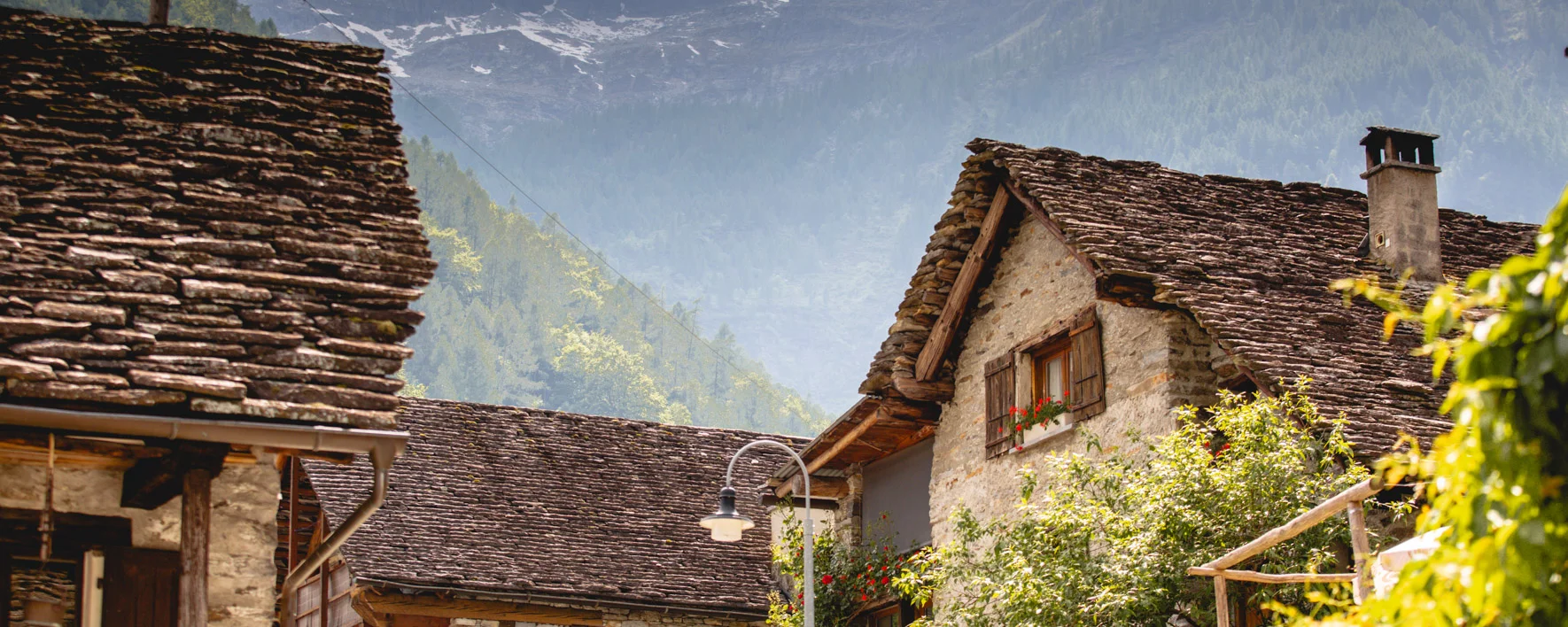
At the end of the valley lies Sonogno, at 918 metres. Stone houses, flowers at the shutters, no through traffic, because the road ends here.
At the entrance to the valley stands the Verzasca Dam, 220 metres high. This is where James Bond leaps into the depths at the start of "GoldenEye". The same jump on a bungee cord costs around CHF 250.
What happened with the pitch in the valley is under "Accommodation / Pitches".


Graubünden
By Rhaetian Railway to Davos
In Filisur we boarded a red train. The village lies on the Albula line, which together with the Bernina line has been a UNESCO World Heritage Site since 2008.
Just after the station the train crosses a high stone viaduct, followed by tunnels, gorges, pine forest and a river far below the tracks. We sat by the window and barely said a word for half an hour [PRÜFEN: Im alten Text steht „Landwasserviadukt". Auf der Strecke Filisur – Davos liegt aber der Wiesener Viadukt, 89 m hoch. Der Landwasserviadukt, 65 m, liegt auf der anderen Seite von Filisur Richtung Tiefencastel. Welchen habt ihr überquert oder gesehen?].
Davos sits at 1,560 metres and is considered the highest town in Europe. Stepping off the train, you quickly see who usually visits: watch shops, big hotels and pricey ski jackets, even in June. More than 700 kilometres of hiking trails surround the town. We opted for a hot chocolate and took the train back.
You can safely leave the car in Filisur for this trip.


Liechtenstein
Vaduz
On the way home we stopped in Vaduz, one of the smallest capitals in Europe. You can only see the castle above the town from outside – the princely family lives there. At the Liechtenstein Center, you can get a passport stamp for a small fee [PRÜFEN: Habt ihr den Stempel geholt? Szene ergänzen]. For a country you can drive across in half an hour, that's a decent souvenir.


Reisetipps
Ob Kreditkarte, Versicherung oder SIM-Karte – hier findet ihr alle wichtigen Themen kompakt zusammengefasst.
Good Travel
More Life

Costs
Travel period: late May to early June 2023, five days, two people. We only wrote down four items on this trip.
| Item | Price |
|---|---|
| Swiss motorway vignette | CHF 40 |
| Simplon car train, Brig – Iselle | CHF 26 |
| Verzasca Valley pitch, one night | CHF 24 |
| Austrian toll | €10 |
| Total | CHF 90 and €10 |
This isn't a total for the whole trip. Missing are fuel, food, the campsite in Sion, the train to Davos and the entry fees for Le Gruyère and Chillon Castle. We didn't note those amounts.
So you can still plan, we looked up current prices. These are not what we spent in 2023.
What it costs today – October 2026La Maison du Gruyère: CHF 8 per person · Chillon Castle: CHF 15 per person [PRÜFEN: auf chillon.ch bestätigen] · Train Filisur – Davos: approx. CHF 10 to 13 per journey [PRÜFEN: auf rhb.ch bestätigen] · Petrol: about CHF 1.98 per litre
Where you can save: by sleeping in the car or a tent, shopping before the border and cooking for yourself. The Attisholz Areal costs nothing at all.
Where it was worth it: the car train, because it saves time and nerves. And the pitch in the Verzasca Valley, despite the night in the water. You only get that location in the middle of the valley there.
Conclusion
The trip in numbers:
- 5 days for a route that deserved ten
- 4 language regions, each with a different way of saying "thank you"
- 3 bikes, one of which was just a passenger
- 2 people in one boot
- 1 puddle we won't forget
Switzerland packs a huge amount into a small space. One morning we stood at a castle on Lake Geneva, two days later in a Ticino valley that looks and sounds like Italy. The roads are good, distances short, and almost everything works exactly as signposted.
Who is it for? Anyone who'd rather be outdoors than in bars and is willing to pay more for it than elsewhere. Switzerland is a great country for a first road trip: it's hard to get lost, and help is never far away.
Who is it not for? Anyone on a tight budget. You can save money, but you can't travel cheaply. And anyone who wants to camp freely like in Scandinavia – the rules here are too strict for that.
What we'll do differently next time: we'll pick one region instead of the whole country and stay put. We'll check the ground and look up before rearranging. And the track bike stays at home.
Thanks for sticking with us to the end. Tell us which valley we don't know yet but should. We already have the coordinate for next time: it's in the Verzasca Valley, a few metres above the dip.
Emma & Consti


Affiliate Links & Kaffeekasse
Danke,
dass du dabei bist!
Bei den mit (*) gekennzeichneten Links handelt es sich um Affiliate Links. Gleicher Preis für dich, eine kleine Provision für uns, um den Blog zu unterstützen! Alternativ kannst du uns auf einen virtuellen Kaffee einladen – wir verzichten für eine bessere Nutzerfreundlichkeit bewusst auf Werbeanzeigen.