
In late August 2023, on our way to Sweden, we spent two days driving through Denmark, the two of us in a borrowed Seat Alhambra. We spent the first night at a beach on Funen and the second day in Copenhagen, and in the late afternoon we crossed the Øresund. In between were two bridge links with a good 20 kilometres of bridge over open water, and a toll we’d covered with a single ticket.
Is it really just a stretch to get through?
Before we left, there was a question on our list: on the way to Sweden, is Denmark a country or just a stretch of road? Most people answer it with the accelerator. Motorway, bridge, bridge, Sweden.
We had the time and wanted to find out. So one driving day turned into a two-day detour. In the end we stood in front of a prison gate that half a generation knows by heart, in front of a throne made of supposed unicorn, and among food stalls on an old shipyard.
This post is part of our road trip through southern Sweden. What came after the Øresund Bridge is in the main post.
Good to know
Tolls. You don’t pay anything on Danish roads. The only things that cost money are the Great Belt Bridge between Funen and Zealand and the Øresund Bridge to Sweden. We booked a combined ticket for both in advance: €85.50 for a car, as of August 2023. After that, we didn’t think about money at any barrier. Today the Øresund Bridge alone costs DKK 470 at the toll station and DKK 420 online, around €63 and €56 respectively (as of 2026). Prices change regularly. Check both operators’ websites before you go; online is almost always cheaper.
Ferry instead of the Great Belt. If you’re coming from Hamburg or eastern Germany, you can skip the Great Belt Bridge: take the ferry from Puttgarden to Rødby or from Rostock to Gedser. The ferry costs money too, but saves kilometres. For us, the bridge route was the simpler sum.
Money. Denmark is in the EU but pays with the Danish krone, around DKK 7.46 to the euro. The rate is pegged to the euro and barely moves. You can pay by card almost everywhere, and in Copenhagen mostly by phone. What matters is a Visa or Mastercard logo on your card. A plain Girocard (the German debit card) won’t get you far at many tills. In Sweden it’s the next krona, and it’s a different one.
Entry and language. A national ID card is enough. There have been repeated checks at the German–Danish border for years, so keep it handy. Almost everyone in Denmark speaks English, and a surprising number speak German.
Prices. Scandinavian level, and a notch higher in Copenhagen. Self-catering from the car, you’ll still get through two days cheaply.
Across the Great Belt

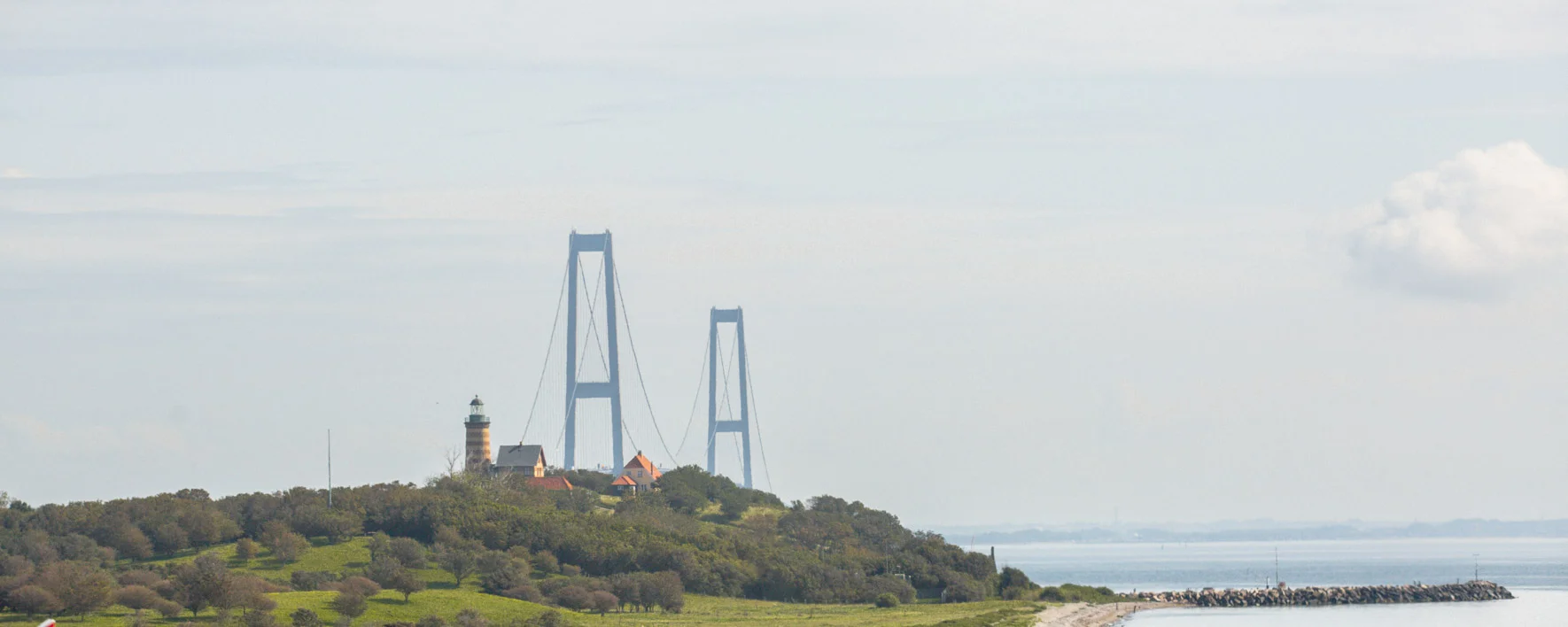
Between Funen and Zealand lies the Great Belt (Storebælt), and the Great Belt Fixed Link crosses it. The part you won’t forget is the East Bridge: a suspension bridge with a 1,624-metre main span, opened in 1998.
Its two pylons are 254 metres tall. That makes them the highest points in Denmark, well above any hill in the country. So you’re driving towards the country’s highest peaks, and they’re made of concrete.
For a few minutes there’s nothing but water to the left and right and two grey towers ahead. We both stopped talking at the same time. Then the bridge was over, and it was motorway again.
Saltofte Strand – the first evening
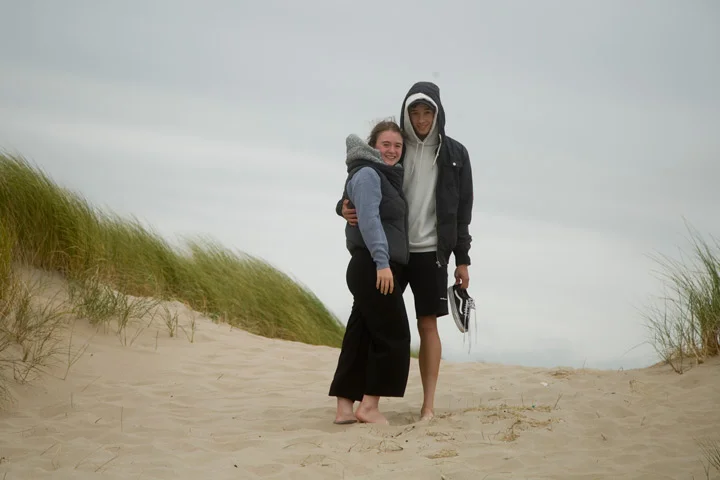
We spent the evening at Saltofte Strand on the west coast of Funen, near Assens. A narrow beach, shallow water, hardly anyone around. We sat on the rocks by the water with our dinner until it got dark, and slept in the car.
There’s something you should know about how Denmark sees that.
Where you’re allowed to sleep in Denmark
When people think of Scandinavia, they think of the right of public access. Sweden and Norway have it. Denmark doesn’t. Wild camping is prohibited, including in your car in car parks. If you’re tired, you may rest in your vehicle until you’re fit to drive again, as long as there’s no sign forbidding it. That’s one night and no more, and camping chairs or an awning in front of the car already turn resting into camping. Many beach car parks have an explicit sign forbidding it. The fines are hefty.
That’s how we did it: one night, nothing set up, off early in the morning [PRÜFEN: Stand dort ein Schild? Wo genau habt ihr gestanden, Parkplatz am Strand?]. But in Denmark, it’s not a place to come back to.
The legal alternative is called a naturlejrplads (a primitive campsite). These are simple spots in woods and on coasts, often with a fire pit, sometimes with a shelter, free or for a few kroner. The catch for us: they’re meant for tents, and cars aren’t allowed on site. For campervans and sleeper cars there are official motorhome stops and campsites. The park4night app shows both.
Next time we’ll take a proper pitch. The beach is still within walking distance.


Copenhagen in a day
Copenhagen in a day works if you cut things beforehand. We settled on four places that have nothing to do with each other: a prison, a canal, a palace and an old shipyard full of food [PRÜFEN: Wie wart ihr in der Stadt unterwegs? Auto geparkt und zu Fuß, Metro, Fahrrad? Wo geparkt?].
Vridsløselille – “Jeg har en plan”

Our first stop was outside the city, in Albertslund. That’s where the former Vridsløselille State Prison stands. If you know the Olsen Gang, you know the gate. In every film, Egon Olsen walks out here, freshly released, with his hat and cigar and the line his pals Benny and Kjeld are waiting for: “I have a plan.” By the end of the film, he’s usually back inside.
The prison has been closed since 2015. The gate is still there, and we stood in front of it, just like Egon. We had a plan too; it was on a note in the glovebox, and it said Nyhavn.
Nyhavn

Nyhavn is the canal with the colourful gabled houses that’s on every Copenhagen postcard. For once, it looks exactly like that in real life. The houses stand shoulder to shoulder by the water, old wooden ships are moored in front, and the ground floors are one restaurant after another.
Hans Christian Andersen lived here for a good twenty years, spread across three different houses. You can’t accuse him of not looking around.
We walked once up the quay and back down the other side. The restaurants are lovely for sitting and expensive for eating. So we ate later, at Reffen.
Rosenborg Castle

Christian IV had Rosenborg built as a pleasure palace in the early 17th century, in the middle of a garden that was then still outside the city. Today the castle is in the middle of the city, and the Danish crown jewels are in the basement.
The most striking piece, though, is upstairs in the Knights’ Hall: the coronation throne, made of narwhal tusk and guarded by three life-size silver lions. Back then, narwhal tusks were thought to be unicorn horns. So a throne made of unicorn wasn’t a matter of taste but a message to every visitor. It reached us. In front of the lions, you automatically lower your voice.
Rosenborg Castle – what it costs today (2026)Adults DKK 140 online, DKK 150 at the ticket desk, approx. €19 to €20 · crown jewels and Knights’ Hall included
Reffen
Finally we drove to Refshaleøen. The island in the harbour used to be home to one of the city’s biggest shipyards. Today it’s the site of Reffen, a street food market made of containers and wooden stalls right on the water. It’s largely built from reused materials, and the stalls work to throw away as little as possible.
The food comes from all corners of the world. We walked up and down the rows three times before deciding, and then queued several times after all: Danish, Asian and African. The African food was the best of the day. Sadly, we didn’t write down the stall’s name. Follow your nose.
ReffenRefshaleøen · open from spring to autumn only, closed in winter · food roughly from midday to evening


Across the Øresund

In the late afternoon we set off towards Sweden. The Øresund Link starts with a tunnel, resurfaces on an artificial island called Peberholm and turns into the bridge there.
The tunnel exists because of the airport. Kastrup sits right on the shore, and a continuous high bridge would have stood in the flight path. So you drive under the planes before you drive over the ships.
The bridge itself is a cable-stayed bridge, almost eight kilometres long. Below lay the Sound in the afternoon sun, ahead lay Sweden. On the other side came an ID check, then Malmö, then a forest for the night.
Conclusion
On this trip, Denmark wasn’t a detour but the first part. Two days were enough for the journey there to stop feeling like just getting there. We’d have missed the moment on the Great Belt, the silver lions and the plate at Reffen if we’d just put our foot down.
Who is the detour worth it for? Anyone driving to Sweden anyway with a day to spare. Copenhagen in a day is ambitious but doable if you stick to a few places. If you want to sleep in your car, be aware that Denmark is much stricter than its neighbours here, and plan for a proper pitch.
Next time we’ll stay an extra day in Copenhagen and sleep at a pitch near the beach on Funen. Everything else we’d do exactly the same.
Thanks for reading all the way to here. The next coordinate is already waiting.
Emma & Consti
Affiliate Links & Kaffeekasse
Danke,
dass du dabei bist!
Bei den mit (*) gekennzeichneten Links handelt es sich um Affiliate Links. Gleicher Preis für dich, eine kleine Provision für uns, um den Blog zu unterstützen! Alternativ kannst du uns auf einen virtuellen Kaffee einladen – wir verzichten für eine bessere Nutzerfreundlichkeit bewusst auf Werbeanzeigen.