
The Cinque Terre were one stop on our Italy road trip in April 2026: eleven days with our Skoda and rooftop tent, from the Dolomites down to Puglia and back. On the way south, we spent a day here. Five villages clinging to a steep coastline above the sea, linked by a railway line that spends most of its time in tunnels. We parked in Monterosso and let the train carry us from village to village. Here's how it works, what it costs and why we skipped one village.
One day, four villages

The Cinque Terre lie on the Ligurian coast in north-western Italy, between Levanto and La Spezia. From north to south they are Monterosso al Mare, Vernazza, Corniglia, Manarola and Riomaggiore. For a long time the villages could only be reached by sea or on steep paths. It was only the railway line that connected them at the end of the 19th century. Since 1997 they've been a UNESCO World Heritage Site together with Portovenere and the offshore islands, and a national park since 1999.
What UNESCO protects isn't just the colourful villages but above all the slopes behind them. Over roughly a thousand years, the inhabitants turned the steep coast into narrow terraces supported by dry stone walls without mortar. At their peak in the 19th century, the terraces covered around 16 square kilometres. Vines, olives and lemons still grow on them today. Some of the harvest is brought down by small monorail trains that wind their way up the slopes. In the past, people carried the grapes in baskets on their heads.
Since the 1950s many families have abandoned their plots, and the population has roughly halved since the 1920s. At the same time, before the pandemic around three million visitors a year came to these five small places. If you've ever stood at the harbour in Vernazza, you can easily imagine it.
Our plan for the day: park in Monterosso, arrive there, then take the train south and end with the sunset in Riomaggiore.
Good to know
How much time do you need? One day is enough for a good impression if you take the train. If you want to hike as well, plan two or three days.
Should you drive there? Only to the edge. You can hardly get into the villages themselves by car – the roads are narrow and parking is scarce. The easiest option is to park at one end and take the train. Monterosso has a large car park on the edge of the village.
When should you go? Early in the day and outside peak season. The Cinque Terre are among the most visited places in Italy, and in summer the narrow lanes get really crowded.
Parking in Monterosso
We parked in Monterosso, the northernmost of the five villages. We paid €24 for the whole day. That's not cheap, but perfectly fine for a day in one of Italy's most visited places.
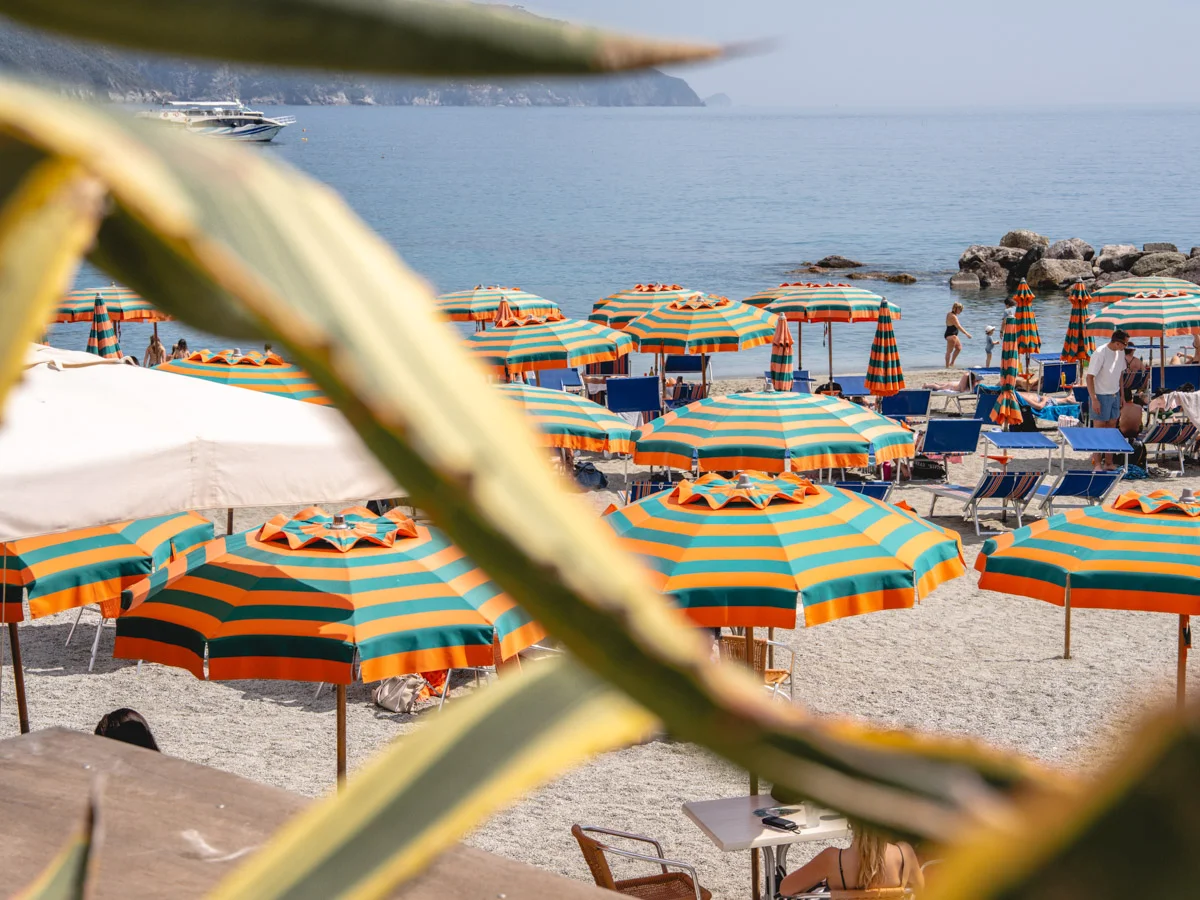
Monterosso has another real advantage: it's the only one of the five villages with a proper sandy beach. We explored the area first and then went for a swim – in mid-April, without hesitation.

Monterosso is the largest of the five villages and the only one with a bit of room to spare. It consists of two parts: the old town and the newer district of Fegina, connected by a short tunnel. At the end of Fegina beach stands “Il Gigante”, a concrete Neptune figure about 14 metres high, dating from 1910. It once supported the terrace of a villa, lost its arms and trident in the Second World War and to storms, and today only holds up the rocks on its back. Monterosso is also known for its lemons and for the anchovies that have been caught and salted here for centuries.
By train from village to village

The railway line connects all five villages. Between two villages you're usually only on the train for a few minutes, and trains run regularly. Almost the entire route runs through tunnels. Now and then the sea flashes past, then it's dark again.
For the journeys we got the Cinque Terre Card with train for €22 per person [PRÜFEN: Aktuell kostet die 1-Tages-Treno-Card im April 29,50 €, ggf. Ticketart oder Preis abgleichen]. With it you can travel as often as you like between Levanto and La Spezia all day. It also covers the paid hiking trails, the toilets at the stations and the small park buses. If you take the train more than two or three times in a day, it quickly pays for itself.
Cinque Terre Card Treno – as of October 20261 day in April €29.50 per adult, 2 days €51, 3 days €68 (prices vary by season) · unlimited regional trains Levanto–La Spezia · paid hiking trails included · station toilets free · we paid €22 per person [PRÜFEN]
Vernazza
Our first stop after Monterosso was Vernazza. The village has a small harbour framed by colourful houses and an old fortress. For many, it's the most beautiful of the five villages.
Vernazza has the only natural harbour in the Cinque Terre and was therefore the most important of the villages in the Middle Ages. Above the harbour towers Castello Doria, an 11th-century watchtower used to look out for pirates. Right by the water stands the 14th-century church of Santa Margherita di Antiochia, whose entrance is unusually at the back, because the sea is at the front.
How vulnerable the villages are became clear on 25 October 2011. Within a few hours, around 380 litres of rain per square metre fell on Vernazza and Monterosso. Mudslides buried Vernazza metres deep, and four people died. That you can hardly see any trace of it today is thanks to many volunteers and residents.


Manarola
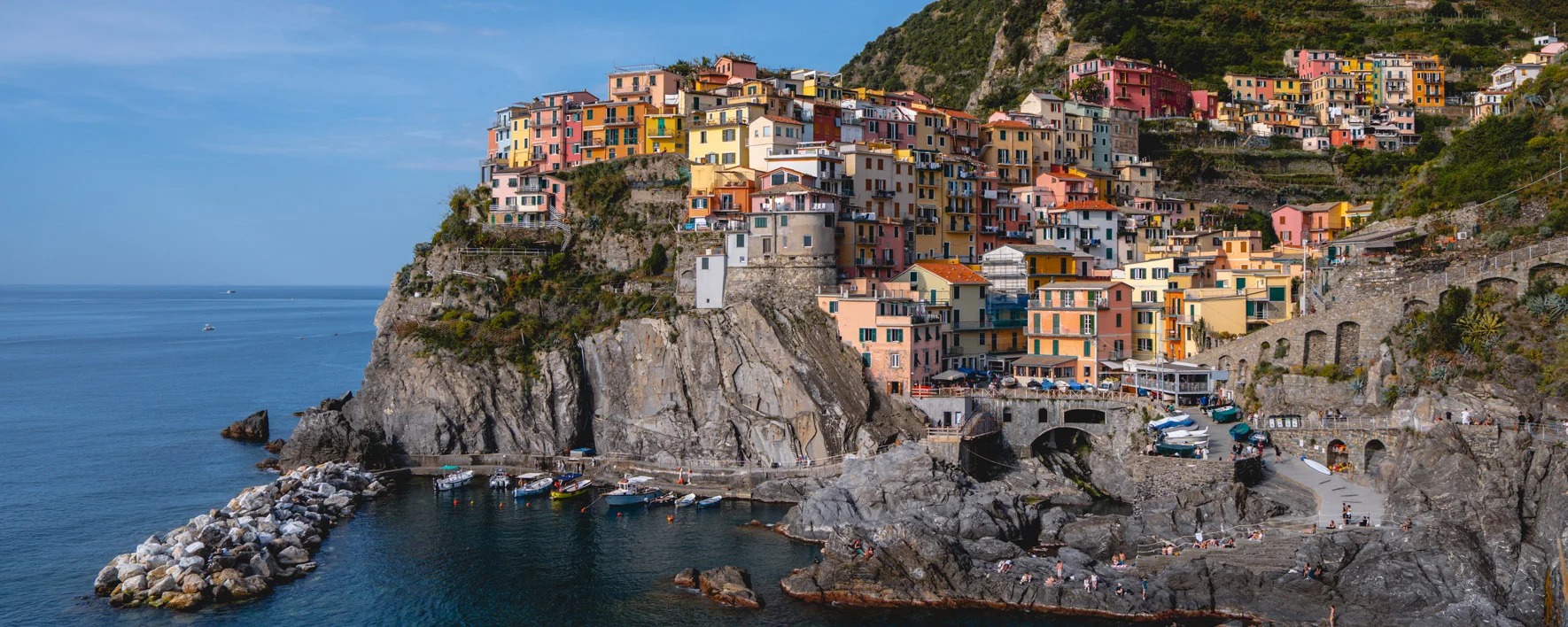
Next we went to Manarola. The houses here are crammed together on a rock above the sea, and from the path at the edge of the village you get the view you know from countless postcards. If you want a photo there without other people, you'll need patience or a very early alarm.
Manarola is considered one of the oldest villages in the Cinque Terre. The church of San Lorenzo in the upper part of the village was consecrated in 1338. Around Manarola they make Sciacchetrà, a sweet dessert wine from grapes that dry for weeks after the harvest. And at Christmas time, a huge nativity scene made of thousands of lights glows on the hillside above the village. A local built it over decades from scrap materials, and it's considered the largest illuminated nativity scene in the world.


Riomaggiore at sunset
We spent the evening in Riomaggiore, the southernmost village. We watched the sun set over the coast and then had dinner in the village.
Riomaggiore is named after the stream that once flowed through the narrow valley and now disappears under the main street. The houses stack up the slope on either side, many with entrances on two levels: down to the lane and up to the next path. Legend has it that the village was founded by Greek refugees in the 8th century. A small 13th-century castle watches over it.
The Via dell'Amore, the region's most famous coastal path, runs between Riomaggiore and Manarola. More on that in the hiking section below.
From Riomaggiore we took the train back to Monterosso and the car in about 20 minutes.


And Corniglia?
We skipped Corniglia. It's the only one of the five villages that isn't right on the sea but high up on a cliff, about 100 metres above the water. From the station, the Lardarina leads up, a staircase with 382 steps in 33 flights, or you can take a small bus. On a day with four villages, that was where we cut corners. If you have more time, include it. Boccaccio already praised the wine from Corniglia in his “Decameron” in the 14th century.
Hiking between the villages
We only took the train that day. But the Cinque Terre are above all a hiking area, and next time we want to walk at least part of it. Here's what we found out.
The Sentiero Azzurro – the Blue Trail
The best-known route is the Sentiero Azzurro, trail number 592. It connects all five villages right along the coast, is about 12 kilometres long in total and takes around five hours without breaks. The highest point is at about 200 metres.
Still, it's only easy in places. Between Monterosso, Vernazza and Corniglia the path constantly climbs and drops on narrow trails and countless steps, often without railings and with the sea right below you.
| Section | Length | Walking time | Elevation gain | Status |
|---|---|---|---|---|
| Monterosso – Vernazza | 3.7 km | approx. 2 h | approx. 220 m | open |
| Vernazza – Corniglia | 4.1 km | approx. 1.5 h | approx. 270 m | open |
| Corniglia – Manarola | 2.2 km | approx. 1.25 h | approx. 120 m | closed since 2012 |
| Manarola – Riomaggiore (Via dell'Amore) | 1.1 km | approx. 25 min | flat | see below |
Information as of October 2026. Closures change again and again after storms, so check the national park website before you go.
For the closed section between Corniglia and Manarola there's a detour over the slopes via the mountain village of Volastra. At around 5.5 kilometres and roughly three and a half hours, it's considerably longer and more strenuous.
Our tip for starters: Monterosso to Vernazza. It's the most strenuous section, but it offers the best views back to Monterosso and ahead to Vernazza's harbour. Set off early and you'll have the trail almost to yourself.
The Via dell'Amore
The Via dell'Amore between Riomaggiore and Manarola is barely more than a kilometre long, carved into the rock and almost flat. It was built in the 1920s, originally as a work path for building the railway. It got its name because young people from both villages met here.
In 2012 it was closed after a rockfall that injured several hikers. Only after twelve years and extensive safety works did it reopen in 2024. New rules have applied since then: you need a Cinque Terre Card and must book a time slot. Up to 100 people can set off every 15 minutes, walking is one-way from Riomaggiore, and you have a maximum of 30 minutes on the path [PRÜFEN: aktueller Status, im Herbst 2026 laut Park zeitweise geschlossen].
The paths on the slopes
If you want to avoid the crowds on the coastal path, you'll find dozens more trails on the slopes above the villages. They lead through vineyard terraces, to pilgrimage churches and to small mountain villages such as Volastra or Groppo. Right at the top, along the ridge, runs the Sentiero Rosso, the Red Trail, from Levanto to Portovenere – almost 40 kilometres and several day stages long [PRÜFEN: Länge]. Most of these trails are free and much quieter.
Hiking in the Cinque Terre – as of October 2026Sentiero Azzurro (592) about 12 km, approx. 5 h without breaks · paid sections only with the Cinque Terre Card, Trekking Card from €10 per day, train ticket not included · Via dell'Amore only with card and booked time slot · bring sturdy shoes, water and sun protection, flip-flops and sandals are banned on the trails [PRÜFEN] · current trail status on the national park website
What it cost
Our expenses in the Cinque Terre, two people, as of April 2026:
| Item | Price |
|---|---|
| Parking in Monterosso, full day | €24.00 |
| Cinque Terre Card with train (2 × €22) | €44.00 |
| Total excluding food | €68.00 |
Conclusion
The Cinque Terre are just as colourful and steep as you'd imagine. And just as busy. If you take the train from village to village, you'll see a surprising amount in one day without having to worry about parking in narrow lanes.
For us the day was a lovely mix of swimming, strolling and train rides, rounded off with a sunset in Riomaggiore.
What we'll do differently next time: arrive earlier and stay at least one night. That leaves time for the walk from Monterosso to Vernazza, for the Via dell'Amore and for Corniglia with its 382 steps.
Thanks for reading this far. The next coordinate is already waiting.
Emma & Consti


Packliste
Du bist noch unsicher, was du alles in deinen Rucksack packen musst? Unsere Packliste hilft dir bei der Planung – mit praktischen Tipps und einer erprobten Liste aus eigener Erfahrung.
Zur Packliste
Pack light
Explore more