

Venice was the last big stop on our Italy road trip in April 2026. One day, one car park on the mainland, a city that recently started charging entry, and a trip to the most colourful island in the lagoon. Here's everything you need to know for a day visit: the fee, the rules, parking, food and how to get to Burano.
Earlier than the tour buses

Our alarm went off early that day, and for good reason. Venice is one of the most visited cities in the world, and around St Mark's Square you really notice it from late morning onwards.
Early in the morning we had it completely to ourselves. Yes, we're tourists too. But you simply enjoy a city's most beautiful places differently when you don't have to share them with a few thousand people.
So our most important tip for Venice isn't a secret spot but a time of day: get there early.
Good to know
How much time should you allow? A full day is enough for the old town and a trip to Burano. You'll have more peace if you stay a night in the city. Then you're there in the evening and morning when the day visitors have gone – and you don't pay the entry fee either.
Can you drive to Venice? Only to the edge. The road across the bridge ends at Piazzale Roma; from there it's on foot or by boat. It's cheaper to park on the mainland and take the bus in.
How big is Venice actually? The old town is spread over about 118 small islands, connected by around 400 bridges and crossed by some 150 canals. The main artery is the Grand Canal, almost four kilometres long and winding through the city in an S-shape. There are no cars in the old town; everything happens on foot or by water, including rubbish collection, ambulances and parcel deliveries.
What does Venice cost? As much as you let it. Around the famous squares it gets expensive quickly; a few lanes further you pay normal Italian prices. More on that below.
A bit of history – a city built on wood
That there's a city here at all is actually remarkable. In the 5th century, people fled from the mainland to the marshy islands of the lagoon, escaping the peoples moving through northern Italy after the fall of the Western Roman Empire. They were safe there because no army could get through mud and shallow water. Over time, these refugee settlements grew into a city.
Venice is literally built on wood. Because the lagoon floor is too soft, the Venetians drove millions of wooden piles into the mud and set platforms of wood and stone on top. Under water and without oxygen, the piles don't rot but become almost as hard as stone over time. Under the church of Santa Maria della Salute alone there are more than a million of them.
The refugee settlement became a world power. For over a thousand years Venice was an independent republic, governed by an elected doge, and as a trading power it controlled large parts of the Mediterranean. Spices, silk and glass from the Orient came to Europe via the lagoon. It was only in 1797 that Napoleon ended the republic.
A few things you'll see on your walks that come with a story:
- St Mark's Basilica owes its name to a theft. In 828, Venetian merchants smuggled the remains of Mark the Evangelist out of Alexandria – according to legend hidden under pork, so the Muslim customs officers wouldn't look too closely.
- The Rialto Bridge was the only bridge across the Grand Canal for centuries. Today's stone bridge dates from 1591; before that there was a wooden bridge here that collapsed or burned down several times.
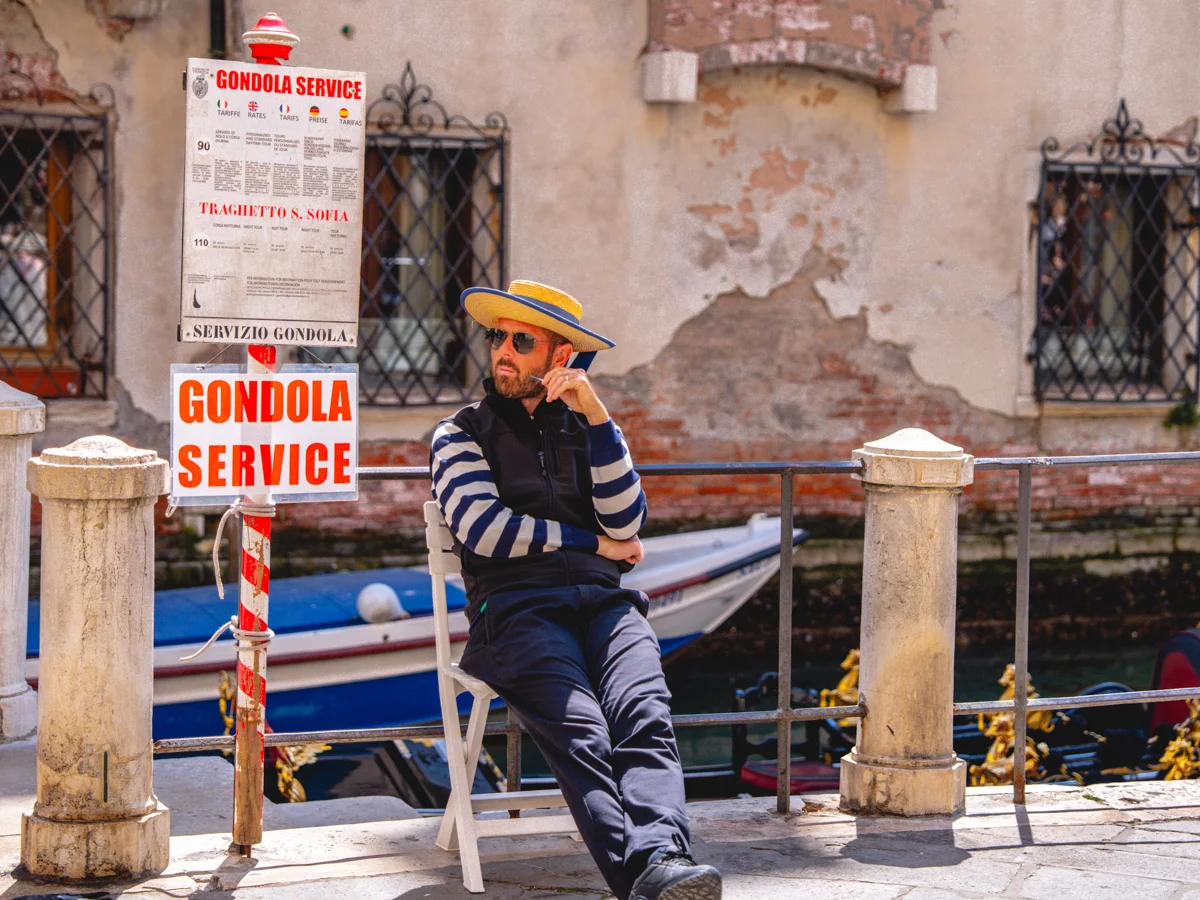
- The gondolas have been black since the 16th century. A decree was meant to stop wealthy families from outdoing each other with ever more lavish boats.
- Acqua alta, the high water, regularly floods St Mark's Square during storms and high tides. Since 2020 the MOSE flood barrier has protected the lagoon: movable gates at the entrances to the sea are raised when high water threatens.
- The residents are becoming fewer. Fewer than 50,000 people live in the old town today; in the 1950s there were more than 170,000. The entry fee is also an attempt to keep the city liveable for them.


Parking and arriving
We parked on the mainland at Venice City Park, €6.50 for the whole day. From there a regular bus runs across the bridge to Piazzale Roma for €1.50 per person per ride. It hardly gets more convenient or cheaper with your own car.
If you drive on to Piazzale Roma or Tronchetto, you can park in multi-storey car parks there. That saves the bus but costs considerably more.
The entry fee – Venice charges admission

Since 2024 Venice has charged day visitors an access fee on certain days, the Contributo di Accesso. In 2026 it applies on 60 days between 3 April and 26 July, mainly weekends and public holidays, from 8:30 am to 4 pm each time. Our visiting day, a Friday at the end of April, was one of them.
Here's how it works: you pay online on the official website cda.ve.it and get a QR code on your phone. There are also stands with QR codes all over the city where you can pay on the spot. Checks are random, mainly at the arrival points.
The price depends on when you book. If you pay at least four days in advance, you get away with €5 per person. Book at short notice or on the day and you pay €10. We were travelling spontaneously and paid the €10 on site.
If you're caught without a valid QR code on a fee day, expect a fine of between €50 and €300.
Contributo di Accesso – 2026€5 per person if booked at least four days in advance · €10 if booked at short notice · applies on 60 days between 3 April and 26 July, 8:30 am–4 pm each day · exempt: overnight guests (free QR code required), children under 14, people with disabilities and one companion · calendar and payment at cda.ve.it
Our tip: check the calendar to see whether your day is affected, and book in good time. Five euros per person saved for a quick look at the planner.
The rules – what's not allowed in Venice

Venice has had enough of tourists treating the city like a theme park, so it has introduced a set of rules. Most are simply common decency. They still get expensive if you ignore them:
- Sitting and picnicking: Don't sit or lie on bridges, steps, monuments or fountain edges, and don't eat sitting on the ground. Costs €100 to €200.
- Swimming: Jumping or swimming in the canals is forbidden. Costs €350.
- Clothing: Walking through the city shirtless or in swimwear costs €250.
- Pigeons and gulls: Feeding them is forbidden. Costs €25 to €500.
- Bicycles: Cycling in the old town is forbidden, and so is pushing a bike. The exception is the route between Piazzale Roma and Santa Lucia station.
- Litter: Leave it behind and you pay €350.
- Camping: Sleeping outdoors costs €200.
- Groups: Guided groups may have no more than 25 people, and loudspeakers are banned.
So for a break, find a bench, a café or one of the small squares away from the main routes. There are more of them than you'd think.
Gondola or water bus?

For many, a gondola ride is part of Venice. But around €80 for just under half an hour was too much for us for a feeling you can get more cheaply.
Instead we took the vaporetto, the public water bus. In Venice it's what buses and trams are elsewhere, running on a timetable along the Grand Canal and out into the lagoon. Don't confuse it with the water taxis: those are private motorboats that cost at least as much as a gondola.
We took the vaporetto to Burano for €9 per person [PRÜFEN: Einzelticket aktuell 9,50 €]. The boat runs about every 20 minutes, and on the way you see Venice from the water. No gondolier, but three-quarters of an hour of lagoon instead.
Burano – the island too colourful for one photo
Burano is about 45 minutes by boat in the north of the lagoon. The island is small and quiet and easy to explore on foot. It's famous above all for its houses: each is painted a different bold colour, pink next to turquoise next to mustard yellow. The story goes that the fishermen painted their houses so brightly to recognise them from the water in the fog. Nobody really knows if that's true. Either way, it would be the most beautiful navigation aid in the world.
We wandered through the lanes and along the little canals, had something to eat and, of course, bought a fridge magnet. Then we took the vaporetto back.
Two or three hours are enough for Burano. If you start early in Venice, you can easily combine the island with an afternoon.


Eating in Venice – two lanes make all the difference
Venice has a reputation as an expensive city, and around St Mark's Square and the Rialto that's true. A scoop of ice cream there easily costs €5, and a plate of pasta more than it should.
Go a few lanes further and it's a different story. In small pizzerias away from the main routes we paid €7 to €8 for a pizza, and a scoop of ice cream cost €2. So you can visit Venice on a budget too. You just have to be willing to get a bit lost. In this city that happens all by itself anyway.
What it cost
Our expenses in Venice, two people, as of April 2026:
| Item | Price |
|---|---|
| Parking at Venice City Park, full day | €6.50 |
| Bus into the city (2 × €1.50) | €3.00 |
| Entry fee, booked on the day (2 × €10) | €20.00 |
| Vaporetto to Burano (2 × €9) | €18.00 |
| Total excluding food and the bus back | €47.50 |
Booking four days in advance would have saved us €10 on the fee.
Conclusion
Venice surprised us. Not because the city is beautiful – we knew that already. But because it can be so quiet early in the morning that you have St Mark's Square almost to yourself. And because it's cheaper to visit than its reputation suggests if you park outside, take the water bus instead of a gondola and eat away from the big squares.
The entry fee and all the rules seem off-putting at first. Once you're there, though, you quickly see why they exist. If you arrive early, show consideration and plan a little, you won't have any problems.
What we'll do differently next time: pay the fee online in good time. And maybe stay a night to hear what Venice sounds like when the last day visitors have gone.
Thanks for reading this far. The next coordinate is already waiting.
Emma & Consti


Packliste
Du bist noch unsicher, was du alles in deinen Rucksack packen musst? Unsere Packliste hilft dir bei der Planung – mit praktischen Tipps und einer erprobten Liste aus eigener Erfahrung.
Zur Packliste
Pack light
Explore more